
Before the city had it’s name
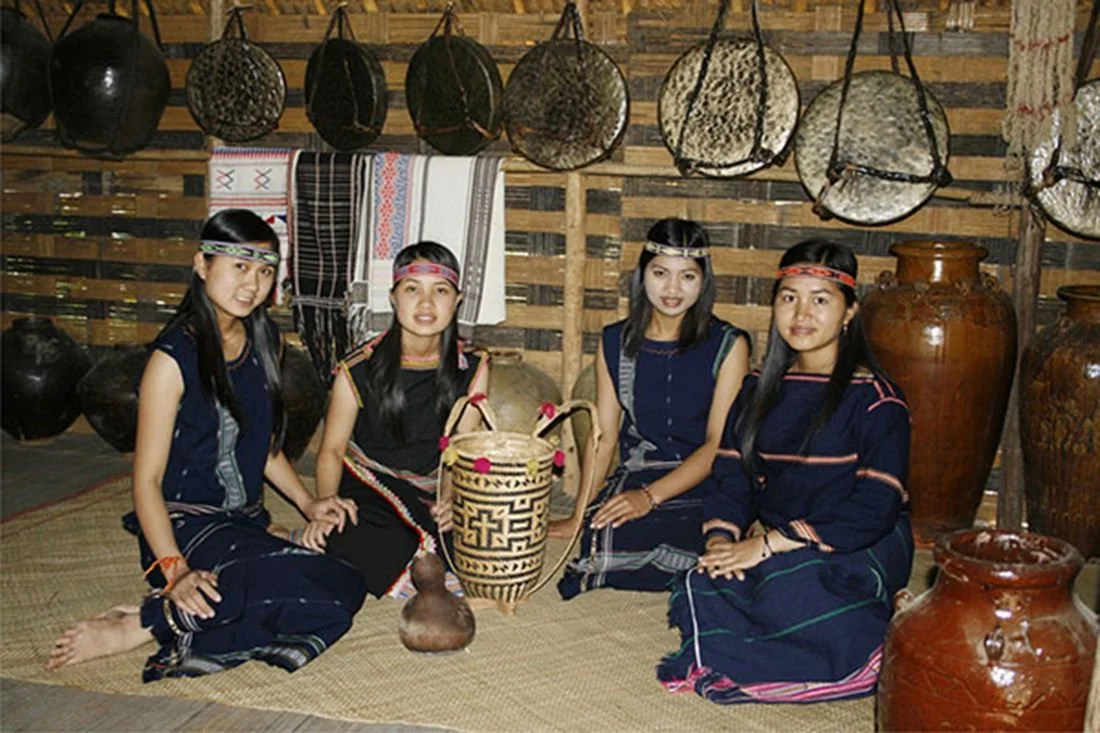
There is a mountain in Lâm Đồng that the K'ho people did not discover.
They were already there.
Lang Biang rises to nearly 2,000 meters above the plateau, its twin peaks visible on clear mornings from the streets of Đà Lạt below. The city's name is a compression of Đà Lạch. Water of the Lạch people. The Lạch are a subgroup of the K'ho, the oldest indigenous group in the Southern Central Highlands, and they named this water long before anyone thought to build a city around it.
That was 2,500 years ago.
The French arrived in the late 19th century and saw in the plateau's altitude and temperate climate the possibility of a hill station. They built railroads. They built villas. They planted coffee. The city that grew up around their ambitions still carries, in its name, the people who were there before all of it.
Most people who visit Đà Lạt don't know this.
Most people who drink coffee from these hills don't either.
The K'ho relationship with Lang Biang is not scenic. It is not the relationship a tourist has with a view. It is older and quieter and more complicated than that.
There is a story the K'ho tell about the mountain. Two young people, K'lang and Ho'Biang, from rival tribes who fell in love and married in secret on its slopes. When Ho'Biang fell ill, K'lang carried her down to the village. The villagers, seeing him as a traitor, shot arrows. Ho'Biang stepped in front of them.
Her father, broken by grief, ended the war between the tribes.
The mountain took their names. Lang Biang. And the people who came from that union became the K'ho.
Reminds you of Romeo and Juliet doesn’t it?
This is not mythology kept in a museum. It is the origin story of a living people, told in a language that belongs to the Mon-Khmer family, spoken across 21 ethnic groups in Vietnam, a linguistic root that runs deeper than the nation-state that now contains it. The K'ho language has no widely used written form. Everything they know, 400 folk tales, 30 epics, one running longer than 6,000 lines, exists in the mouths of people who learned it from other mouths.
When those mouths are gone, the library closes.
Drive the mountain roads around Lang Biang in the evening and the fog comes down fast. The air is thin enough up here that you notice it. Not dramatically. Just a slight lightheadedness. A reminder that you are somewhere the body wasn't entirely designed for, and that the people who live here have spent 2,500 years adapting to exactly that.
The pollution levels in Lâm Đồng are among the lowest in all of Vietnam. The air is clean in the way that only altitude and distance from industry can make it. You breathe deeply without thinking about it.
Below the fog, in the valleys and on the terraced hillsides, the K'ho farm.
Strawberries. Tomatoes. Peppers. Flowers for the cities. And coffee. Always coffee. The K'ho and their neighboring highland communities produce an extraordinary share of Vietnam's agricultural output from this plateau. The vegetables on tables in Hồ Chí Minh City. The flowers in Hà Nội markets. The arabica in specialty cups from Saigon to Seoul.
It comes from here.
From them.
The K'ho are a matriarchal people. The women lead. The eldest women anchor the family structure. After marriage, the husband moves to his wife's home. The children take their mother's name. A daughter is considered fortune. She will choose her own husband, carry the family forward, inherit the land.
In a K'ho household, the woman decides.
This is not a relic. It is present tense. In the villages around Lang Biang today, women run the farms, manage the harvest decisions, negotiate the sales. The matriarchy and the agriculture are not separate systems. They are the same system.
The K'ho also hold to a spiritual understanding of the land that predates every religion that has since arrived on the plateau. They believe in Yang, the gods who bless, and Cha, the spirits who harm. Every significant moment in the agricultural cycle has its ceremony. The sowing. The flowering. The harvest. Offerings made not as superstition but as acknowledgment that the land gives, and that the land is owed something in return.
Coffee arrived into this worldview. It didn't replace it.
There are two farms near Lang Biang worth knowing about. Not because they are the only ones, but because they are windows.
The first belongs to a K'ho family whose great-grandfather planted arabica Bourbon trees roughly a hundred years ago, from seeds introduced during the French colonial period. Those trees are still producing. His great-granddaughter Rolan Co Lieng now runs the farm and roastery alongside her husband Josh, who arrived in Vietnam on a motorcycle, wandered into a community fire dance in her village, and never quite left. They have four children. The children play in the coffee rows on weekends while their grandparents work the same trees the great-grandfather planted.
The second belongs to the family of a K'ho woman named Lim, whose farm sits at the foot of Lang Biang. Her family had grown coffee for generations. A Slovak man came to Nha Trang on a beach holiday, received a message from a shy farm girl who wanted to practice English, drove three hours into the mountains to meet her, and eventually moved into her family's village for good. He learned to pick cherries. He built raised drying beds. He sent the first shipment to Slovakia in jute bags with handwritten labels.
Both families share one detail that stops you cold.
For generations, the K'ho farmers who grew this coffee never realized it’s place in global commerce. They sold the cherries, fresh or dried, into a commercial chain that moved the value somewhere else. The cup their labor produced was never theirs.
That has begun to change. Slowly. On specific hillsides. In specific families.
The K'ho are 200,800 people. 88.9 percent of them live in rural areas. The poverty rate is 12.1 percent.
Those numbers sit inside a region that feeds a nation.
Lang Biang will be there long after the specialty coffee industry has moved on to its next discovery. The fog will come down in the evenings. The air will stay clean. The women will make the decisions. The ceremonies will mark the seasons, or what remains of them. The children will play in the rows of coffee trees.
Another Coffee, Another Time.
until then.
-Tommie Vo
-26 Apr 26
