
Give me Liberica or Give me Death
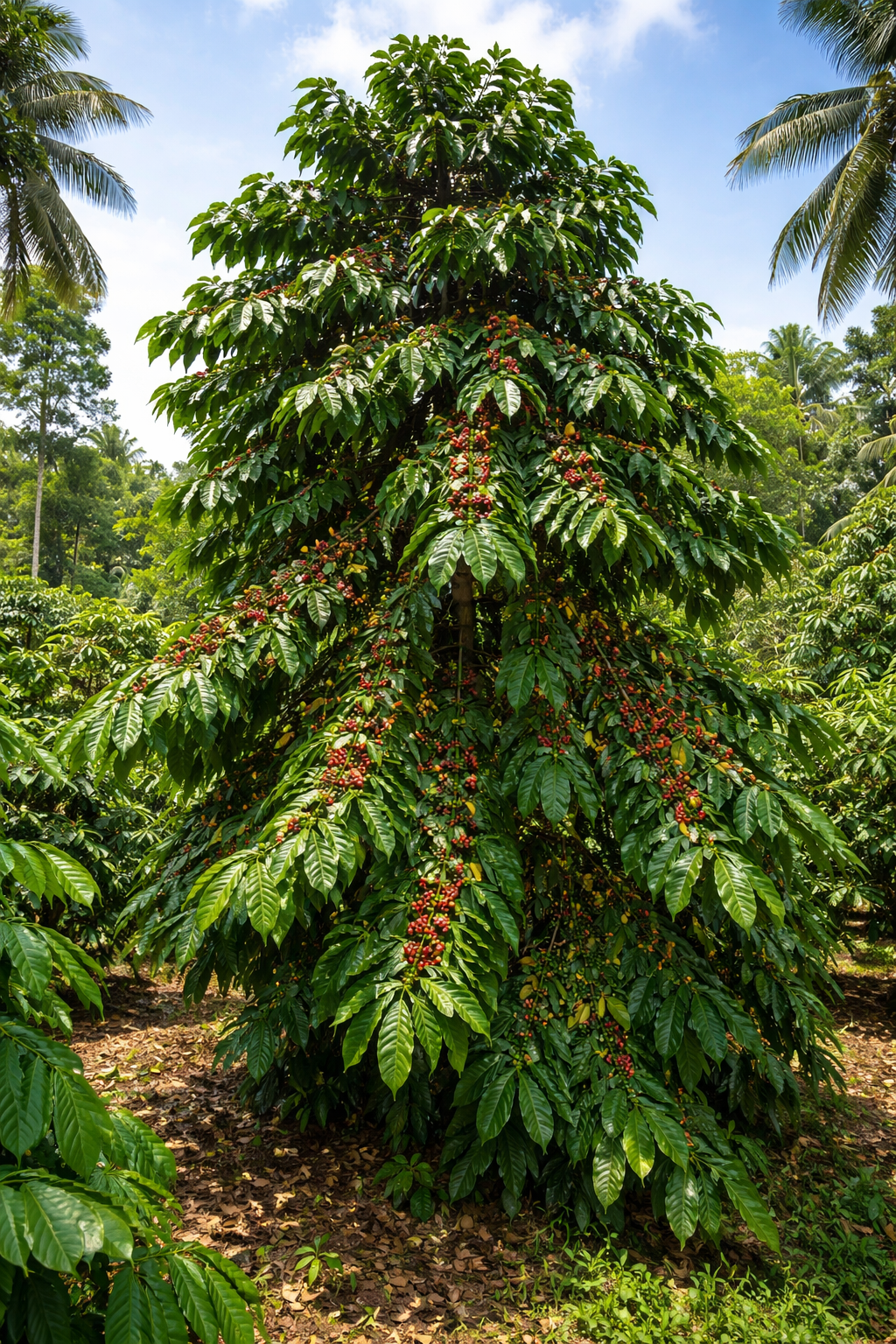
The tall and mighty Liberica Tree
Most of us grow up believing coffee comes in two forms.
Arabica, the refined one.
Robusta, the workhorse.
One is treated like wine. The other like fuel. Together, they make up almost everything we drink, argue about, and post photos of. But coffee, like most things that get industrialized, used to be much bigger than the version we inherited.
There are more than two hundred species in the Coffea genus. And yet global taste has narrowed itself to two. Somewhere along the way, an entire species slipped quietly out of the conversation. Not because it failed but rather because it didn’t cooperate.
That species is Coffea liberica.
A Coffee That Never Learned How to Behave
Liberica doesn’t grow like coffee is “supposed” to grow.
Arabica stays polite. It grows as a manageable shrub, rewards altitude and care, and fits neatly into rows, spreadsheets, and expectations.
Liberica grows as a tree.
Left alone, it can stretch well beyond ten meters tall. Its leaves are massive and leathery. Its cherries are oversized. Its beans are large, asymmetrical, and immediately recognizable once you’ve seen them. Nothing about Liberica is subtle or efficient.
And that explains a lot.
Large trees demand space. Space costs money. Harvesting tall trees costs labor. Liberica needs more of both, in a world increasingly obsessed with doing more with less. It also refuses to cooperate at harvest time. Its cherries don’t politely fall when ripe. Leave them too long and fermentation begins on the branch. Handle them carelessly and the results can be unforgiving.
For decades, that’s exactly how Liberica was handled.
How Liberica Rose - and Then Disappeared
Liberica wasn’t always obscure.
In the late 19th century, when coffee leaf rust tore through Arabica plantations across South and Southeast Asia, growers scrambled for alternatives. Liberica stepped in. It tolerated heat. It grew at lower altitudes. It survived where Arabica failed.
For a brief window, a few decades at most, Liberica stood alongside Arabica as a serious global crop.
Then reality set in.
Processing Liberica was difficult. Drying was inconsistent. Transport in humid conditions ruined harvests. The flavors, when mishandled, were unfamiliar and often unpleasant to a market trained on Arabica’s sweetness.
And then Robusta arrived.
Robusta was compact, productive, resilient, easy to process, and forgiving of industrial handling. It blended well. It scaled effortlessly. It behaved.
Liberica did not.
So it was replaced. Not because it was inferior, but because it was inconvenient.
Taste Was Never the Real Problem
Ask ten people about Liberica and you’ll get ten different reactions. That alone should tell you something.
Liberica is polarizing because it is expressive. It doesn’t hide easily behind roast or milk unless you force it to. When handled well, it can be shockingly aromatic - floral, fruity, and naturally sweet in a way that feels closer to fruit than sugar.
In Vietnam, Liberica is often called cà phê mít (literally jackfruit coffee). The name isn’t marketing. It’s descriptive. Many Liberica lots carry a fragrance that unmistakably recalls ripe jackfruit: intense, tropical, impossible to ignore.
That was my introduction to it.
A roaster I trusted handed me a bag they hadn’t released yet. Something new they’d been quietly working on. When I opened it, I stopped. I genuinely didn’t know coffee could smell like that. The aroma was overwhelming. floral, fruity, sweet, almost like opening a perfume sampler by accident.
I felt like i had just found something special, in fact i had.
The sweetness carried through. Not added. Not implied. Just there. It felt like discovering a back room in a building I thought I already knew.
Why Liberica Tastes the Way It Does
Liberica is chemically different.
It contains less caffeine than Arabica and far less than Robusta. It contains more sugar, which explains both its sweetness and its volatility. High sugar content makes fermentation powerful and unforgiving. Get it right and the cup sings. Get it wrong and it collapses into funk.
This is where Liberica earned its reputation.
For years, it was roasted dark to bury its excesses. The result was a coffee described as woody, smoky, earthy, sometimes muddy. Dark roasting flattened its character, turning something expressive into something merely loud.
Modern processing has changed that.
Better harvesting, controlled fermentation, careful drying, and lighter roasting have revealed what was always there. Tropical fruit. Creamy, lactic textures. Floral aromatics. A sweetness that feels intrinsic, not engineered.
Sometimes jackfruit. Sometimes banana. Sometimes mango. Sometimes something closer to cream or mascarpone.
It is not subtle. It is not polite. It is not for everyone.
That may be its greatest strength.
The Quiet Return
Today, Liberica exists mostly on the margins, in Southeast Asia, parts of West Africa, and small pockets where farmers never fully abandoned it. In Vietnam, the Philippines, and Malaysia, it survives as a local coffee, a cultural staple, or a niche specialty offering.
It remains rare. Less than one percent of global production.
But it’s being looked at again.
Climate pressure has a way of reopening old conversations. Arabica is fragile. Robusta is resilient but blunt. Liberica , heat-tolerant, deep-rooted, genetically distinct, is being reconsidered, not as a replacement, but as an alternative.
Not everything needs to be optimized into sameness.
Why Liberica Matters
Liberica isn’t important because it’s exotic. Or rare. Or unusual.
It matters because it reminds us that taste is learned, not fixed. That entire categories of experience can be dismissed not because they lack value, but because they resist standardization.
Liberica asks more of everyone involved: farmers, processors, roasters, drinkers. It refuses to be reduced to a checkbox flavor wheel.
You don’t have to love it.
But once you’ve tasted it, it becomes hard to pretend coffee is only two things anymore.
And maybe that’s the point.
Tommie Vo
19 Jan 2026
